
Aksesibilitas
100%
1.5
1.0
100%
Biro Organisasi, SDM dan Reformasi Birokrasi
JAKARTA — The Ministry of Villages and Development of Disadvantaged Regions (Kemendesa PDT) held a consolidation meeting in South Jakarta on Monday (October 19, 2026) to align mechanisms for proposing and executing Competency Tests for Community Empowerment Functional Positions (Penggerak Swadaya Masyarakat / PSM). This consolidation was conducted to ensure that competency test execution operates more effectively, systematically, and in compliance with the latest regulations.
This alignment follows the issuance of Regulation of the Minister of Villages and Development of Disadvantaged Regions Number 8 of 2026 regarding Amendments to Regulation of the Minister of Villages and Development of Disadvantaged Regions Number 4 of 2025 concerning the Implementation of Competency Tests for Community Empowerment Functional Positions. This regulatory amendment accommodates several operational adjustments, including mechanisms for forming examiner teams and implementation support, ensuring execution runs efficiently and in line with institutional demands.
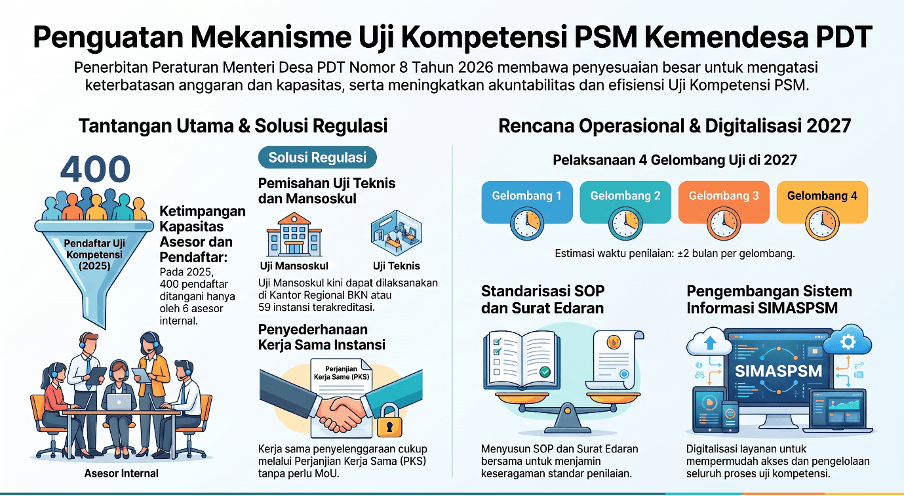
Senior Community Empowerment Officer (PSM Ahli Madya) at the Center for Functional Position Fostering (PPJF), Widyanto Ramadhan, explained that in 2025, the number of competency test applicants reached approximately 400 individuals, whereas Kemendesa PDT possessed only six certified assessors. This imbalance posed challenges in meeting evaluation demands while maintaining cost efficiency, particularly regarding the engagement of external assessors.
Under the latest regulation, competency test mechanisms for user agencies have been adjusted, notably through the separation of Technical Competency Tests and Managerial and Socio-Cultural (Mansoskul) Competency Tests. Managerial and Socio-Cultural tests can now be administered at Regional Offices of the National Civil Service Agency (BKN) or across 59 BKN-accredited organizing institutions. Furthermore, inter-agency implementation partnerships can now be established directly through Cooperation Agreements (PKS) without requiring a prior Memorandum of Understanding (MoU).
Chaired by Senior Human Resources Analyst (Analis SDM Aparatur Ahli Madya), Zulkarnain, the meeting also addressed the imperative for operational clarity during test execution. Legal Bureau Representative Hani Witjaksono emphasized the necessity of drafting Standard Operating Procedures (SOP) as operational guidelines for both Technical and Mansoskul competency tests, ensuring that every stage follows a clear workflow and administrative mechanism.
Meanwhile, Junior HR Assessor (Asesor SDM Aparatur Ahli Muda), Magdalena Simamora, noted that capacity constraints among internal assessors within the Bureau of Organization, HR, and Bureaucratic Reform (OSDMRB) must be factored into execution planning. Assessment processes require meticulous preparation and scheduling, with an estimated timeframe of approximately two months for each assessment batch.
As a follow-up action, Kemendesa PDT plans to formulate a Joint Circular Letter (Surat Edaran) to establish procedural certainty and maintain uniform evaluation standards. The PPJF also projects conducting competency tests across four batches in 2027. Additionally, the development of the SIMASPSM information system is planned to facilitate service access and support the management of competency testing processes.
Through this consolidation, Kemendesa PDT continues to drive the structural strengthening of PSM Functional Position competency testing to ensure execution becomes increasingly structured, efficient, and accountable. Regulatory alignment, SOP drafting, assessor capacity planning, and information system development are expected to support more optimal competency testing services for candidates and user agencies alike.
Author: Mukhlis As