
Aksesibilitas
100%
1.5
1.0
100%
Biro Organisasi, SDM dan Reformasi Birokrasi
JAKARTA – The Ministry of Villages and Development of Disadvantaged Regions (Kemendes PDT) conducted monitoring and evaluation (Monev) on the implementation of the agile work system across all work units to ensure bureaucratic transformation runs effectively and aligns with organizational needs. The activity was held through a coordination meeting at Executive Meeting Room 2, 3rd Floor, Kemendes PDT Main Building, South Jakarta, on Wednesday (November 11, 2026).
The meeting, which commenced at 09:00 WIB, involved bureau representatives within the Secretariat-General, Persons in Charge (PICs) from Echelon I Work Units, and the Business Process Working Team at the Bureau of Organization, Human Resources, and Bureaucratic Reform. Discussions focused on evaluating the implementation of the new work mechanism, which prioritizes flexibility, collaboration, and strengthening civil servant competencies through an agile organization approach.
Transitioning toward a more adaptive organization is part of bureaucratic simplification efforts, while encouraging work patterns that no longer rely entirely on conventional hierarchical structures. Through the agile work system, task execution is expected to become more dynamic by optimizing collaboration across employees and work units based on competencies and organizational needs.
This monitoring and evaluation aims to identify the alignment of work mechanism implementation within Echelon II Work Units and Technical Implementation Units (Unit Pelaksana Teknis / UPT), while mapping out operational challenges encountered during execution. Evaluation results will subsequently serve as the basis for formulating improvement recommendations to ensure the new work system is applied consistently across the entire ministry.
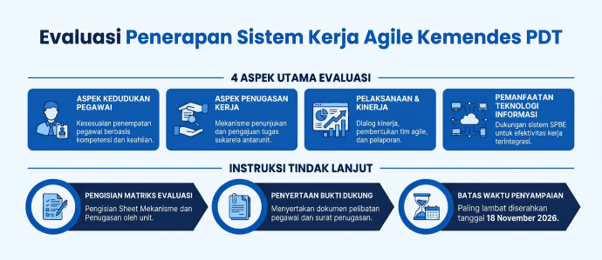
The Monev execution refers to Minister of Administrative and Bureaucratic Reform (PANRB) Regulation Number 7 of 2022 concerning Work Systems in Government Agencies, as well as Minister of Villages and Development of Disadvantaged Regions Regulation Number 1 of 2024 concerning the Organizational Structure and Work Procedures of the Ministry. During the discussions, the evaluation covered four primary aspects:
First, the positioning aspect, which assesses the alignment of employee placement in functional positions and implementing positions based on competencies and expertise.
Second, the assignment aspect, which encompasses mechanisms for formal appointment as well as voluntary applications for task execution, spanning internal work units, cross-unit assignments, and inter-agency deployments.
Third, the task execution, performance management, and accountability aspect, which includes performance dialogues or expectation clarification, the formation of internal working teams or agile teams, and reporting mechanisms for task outcomes.
Fourth, the utilization of information and communication technology (ICT) aspect, which evaluates the support of Electronic-Based Government System (Sistem Pemerintahan Berbasis Elektronik / SPBE) applications in facilitating an integrated work mechanism.
As a follow-up, every work unit is requested to complete a monitoring and evaluation matrix via documents provided by the implementing team. Entries cover the Mechanism Sheet and the Assignment Sheet, accompanied by supporting evidence in the form of employee engagement request documents and official assignment letters. Technical coordination is also conducted through designated PICs within each respective work unit.
All heads of Echelon II Work Units and UPTs are expected to instruct their staff to finalize the evaluation matrix once the official internal memo (nota dinas) is issued. Monitoring and evaluation results must subsequently be submitted via internal memo to the Head of the Bureau of Organization, Human Resources, and Bureaucratic Reform no later than November 18, 2026.
Through this evaluation, Kemendes PDT strives to ensure that the agile work system goes beyond mere administrative procedural changes, fostering a collaborative, adaptive, and results-oriented work culture. Ultimately, this organizational transformation is expected to enhance task execution effectiveness, service quality, and overall ministry performance achievements.
Text: Mukhlis As