
Aksesibilitas
100%
1.5
1.0
100%
Biro Organisasi, SDM dan Reformasi Birokrasi
JAKARTA — The Ministry of Villages and Development of Disadvantaged Regions (Kemendes PDT) conducted an evaluation of the trial implementation of the Work From Home (WFH) feature on the E-Presensi application, which took place from August 1 to October 16, 2026. All work units and personnel were requested to participate in the evaluation by completing a questionnaire and submitting reports no later than October 24, 2026.
This directive was communicated via Official Memorandum Number 2093/BPI.03.01/X/2026 dated October 20, 2026, signed by the Head of the Bureau of Organization, Human Resources, and Bureaucratic Reform of Kemendes PDT, Hasrul Edyar. The evaluation aims to gather insights regarding the execution of the WFH trial while providing baseline data to refine employee attendance policies.
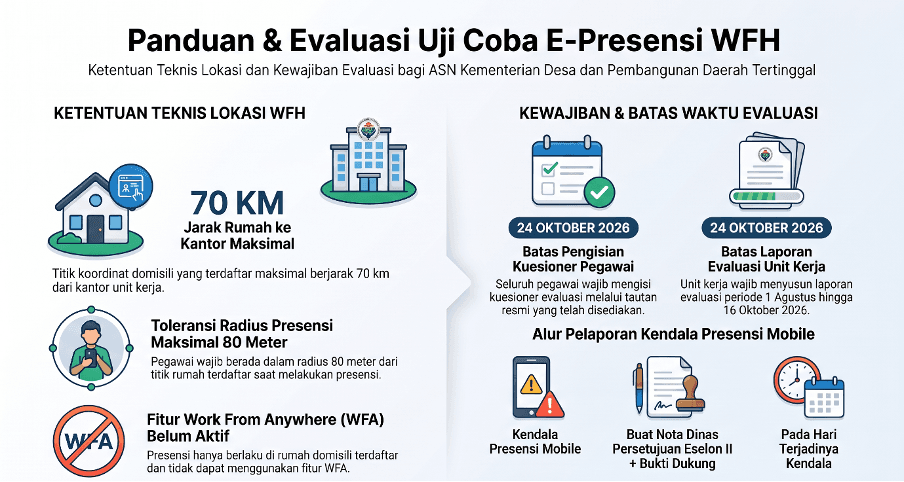
During the trial period, employees operating under WFH arrangements were required to record their attendance from their registered place of residence listed in official personnel records. Technical guidelines stipulated specific geographic radius boundaries: a maximum distance of 70 kilometers from the primary work unit for registered residential coordinates, and a maximum tolerance of 80 meters from registered coordinates when logging daily attendance. Meanwhile, the Work From Anywhere (WFA) feature has not been enacted within Kemendes PDT.
Attendance logging during WFH remains conducted independently via the E-Presensi Mobile application or Face Recognition terminals. In the event of technical glitches, employees are required to submit an official memorandum to secure approval from their respective Echelon II unit head on the same day.
Furthermore, the utilization of the E-Konfirmasi feature is strictly prohibited as a substitute for WFH attendance logging. The E-Konfirmasi feature is designated exclusively for confirming authorized absences, including official leave, duty travel, external meetings, and training sessions. Employees executing WFH obligations also remain mandated to submit daily performance logs via BKN's E-Kinerja application.
All work units and personnel are expected to submit reports and complete the evaluation questionnaire prior to the October 24, 2026 deadline. Through this evaluation, the Bureau of Organization, HR, and Bureaucratic Reform will consolidate feedback across work units and staff to assess the effectiveness of WFH implementation, the reliability of facial and location verification, and operational bottlenecks encountered during the trial phase.
The evaluation outcomes are expected to serve as the foundation for defining corrective measures and subsequent policies regarding WFH implementation within Kemendes PDT. Active participation from all employees and work units in completing questionnaires and submitting reporting data remains crucial to ensuring that enacted policies operate in an orderly, accountable manner that supports overall organizational performance.
Author: Mukhlis As